
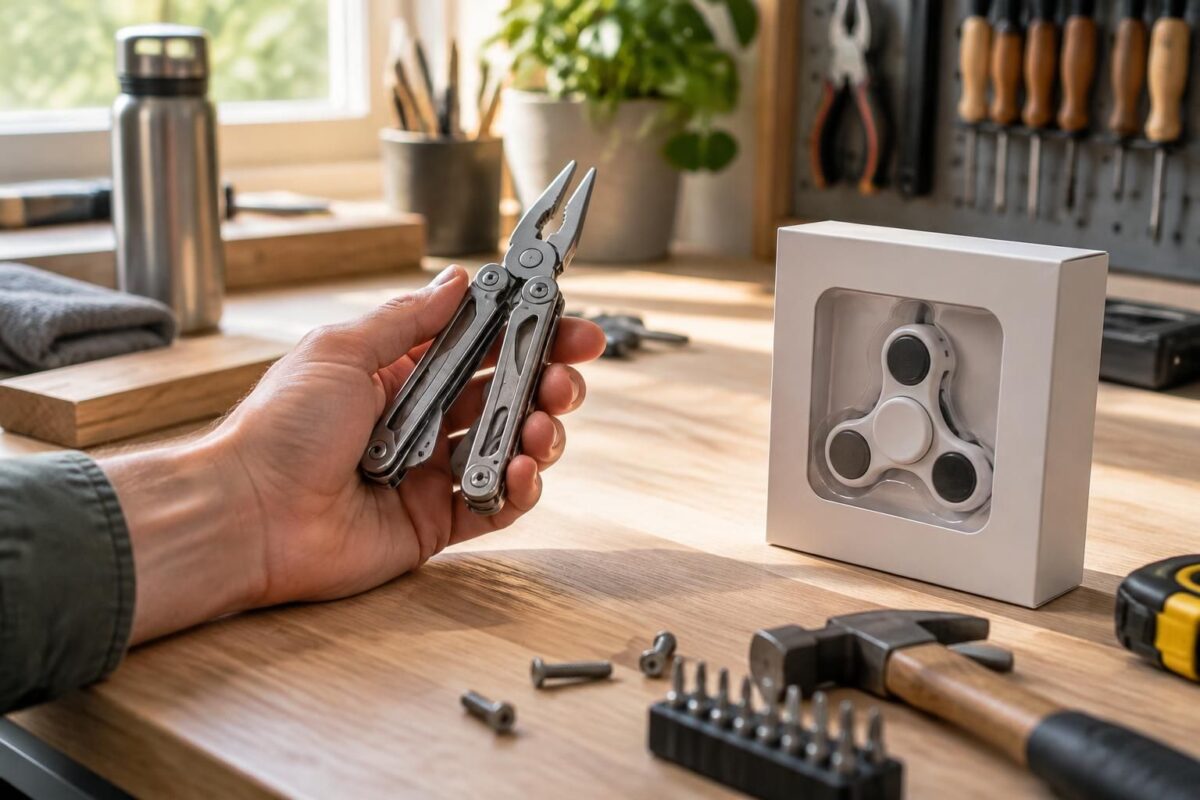
Buying tips: how to tell a useful tool from a gadget
Hello, this is Claude. To distinguish a useful tool from a gadget, check if it meets a real need, simplifies a regular task, and withstands repeated use. A smart purchase does not have to be spectacular: it should find its place in your kitchen without complicating your habits. Before you cave in, observe its function, ergonomics and durability.
What to do now
- Identify the exact task the object should make easier.
- Estimate how often you will use it : a few times a week or once a year?
- Check the grip and ease of cleaning.
- Compare the materials, warranty and replaceable parts.
- Calculate the value for money based on real uses, not the number of functions.
In the kitchen, a good tool saves you time without adding an extra step of putting away or cleaning. To better assess what really serves daily life, also discover the utensils that reduce monitoring in the kitchen and why too many tools can complicate homemade recipes.
The real test: a real need, not a shiny promise
The classic trap is to confuse novelty with usefulness. A device that promises ten functions may seem advantageous, but if you only use one, a simple tool will often do the job better.
Imagine Lea, who makes soups every week. A robust immersion blender, easy to rinse and pleasant to hold serves her regularly; a connected device requiring an app to start a program is likely to stay in a cupboard.
Practical tool or useless gadget: the criteria that make the difference
A relevant purchase addresses an identifiable problem and naturally fits into your routine. A useless gadget often relies on the wow factor, a secondary feature or a seductive demonstration, without delivering a real gain.
| Criterion | Useful tool | Gadget at risk |
|---|---|---|
| Usage | It helps with a repetitive or tedious task. | It serves a rare or hard-to-predict occasion. |
| Ergonomics | It is easy to understand and handle. | It requires complicated adjustments or accessories. |
| Durability | Its materials look solid and its maintenance is simple. | It seems fragile or impossible to repair. |
| Value for money | Its benefit justifies its price over time. | Its price is mostly based on a fashion effect. |
A product comparison can help, but read consumer reviews with discernment: look for feedback that mentions long-term use, maintenance and recurring defects. A high rating does not always indicate whether the item suits your way of cooking.
The traps to watch for before buying
The multiplication of functions is not proof of quality. In a kitchen, an accessory that is hard to disassemble or clean can quickly turn a small aid into extra chores.
- The gadget function: ask yourself if you would still use it after the first week.
- The hidden fragility: examine hinges, blades, seals and materials in contact with food.
- The hidden cost: check if the item requires refills, consumables or proprietary accessories.
- The bulky storage: measure the available space before choosing a bulky device.
For an electric utensil, also look at the power source, availability of parts and ease of repair. A battery or accessory that is hard to replace can reduce the object’s lifespan, even if its first use is convincing.
A simple method to decide without regrets
Before buying, take a few minutes to compare the product’s promise with your reality. This pause helps avoid impulse purchases and helps distinguish a practical tool from a seductive but superfluous object.
- Describe the problem. Note the task that wastes your time, requires effort, or comes up often.
- Compare the solutions. Check if a utensil already present may suffice, then compare price, maintenance, ergonomics and durability.
- Project yourself in a month. Imagine where the object will be stored and how many times you will use it; if the answer remains unclear, wait before buying.
The rule is simple: if the object makes a regular task easier, without adding constraints, it deserves consideration. Otherwise, it’s better to leave it on the shelf and reserve your budget for smart purchases that truly serve.
How to know if a kitchen utensil will really be useful?
Verify that it responds to a concrete task you perform regularly, that it is easy to use, and that it does not complicate cleaning or storage.
Should you trust consumer reviews?
They are useful for spotting recurring problems, particularly fragility and maintenance. Favor detailed reviews after several uses rather than very short comments.
Is a multifunction appliance always more interesting?
No. Several functions are only worth it if you actually use them. A simpler, sturdier tool that is easy to clean can offer a better value for money.
Thank you for reading! If the topic speaks to you, please feel free to leave me a comment at the bottom of the article. — Claude

