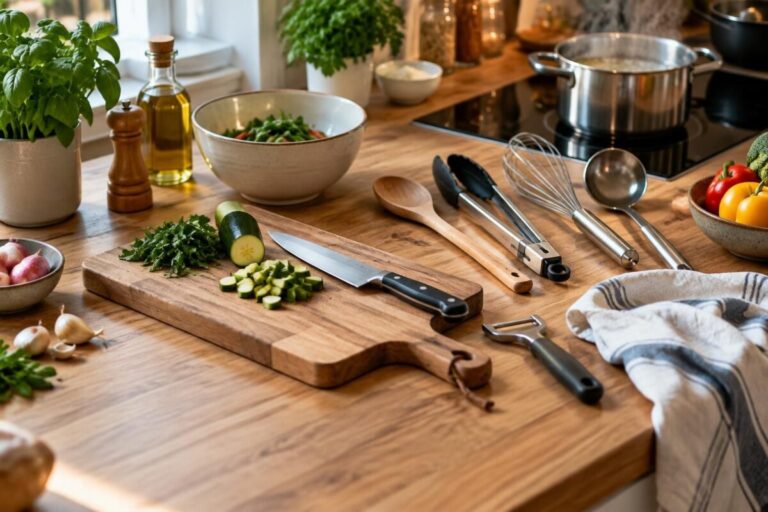

Forgotten utensils: the one that can save your rushed evenings
Hello, Claude here. The forgotten utensil that can really save your busy evenings is the multifunction food processor. It chops, blends or grates while you prepare the cooking, without multiplying the manipulations.
A good knife and an efficient pan remain valuable, but this device saves precious minutes when the days run over. Here’s how to choose practical tools that make fast cooking easier, without turning your cupboards into an equipment store.
Do it now
- Identify the tasks that slow you down: chopping, grating, blending, or kneading.
- Choose a multifunction food processor with the accessories suited to these actions.
- Keep a sharp chef’s knife for quick and precise preparations.
- Use a stable, non-slip cutting board to work comfortably.
- Complete your equipment with a non-stick pan and a thick-bottomed saucepan.
The robot is the most versatile ally if you cook often; for occasional use, a good knife and a pan can be enough. To choose utensils suited to weeknight meals or spot the essential accessories for cooking with peace of mind, first think about the motions you repeat most.
The multifunction robot, an underestimated ally for busy evenings
Among forgotten utensils, the multifunction robot is often left at the back of a cupboard, while it can chop vegetables, blend a soup or grate cheese in moments. It does not replace the whole cooking, but it reduces the preparation steps and the associated washing up.
Imagine an evening when you need to prepare a tomato sauce and vegetables to accompany pasta. While the water is heating, the robot can chop onion and carrot; the pan and the pot take over next. The time savings come mainly from these tasks done in parallel.
Robot, knife or pan: which tool to choose first?
The robot is handy for repetitive cuts or blended preparations. The chef’s knife remains more immediate for small quantities, while the non-stick pan makes quick cooking easier with little sticking and easier cleaning.
The thick-bottomed saucepan complements this set nicely: its heat is distributed more evenly, which helps to cook a sauce or a soup without watching every second. The idea isn’t to buy all the equipment, but to choose the one that fits your habits.
| Utensil | Typical use | Advantage for busy evenings |
|---|---|---|
| Multifunction robot | Chop, blend, grate | Speeds up several prep tasks |
| Chef’s knife | Cut vegetables and proteins | Precision and efficiency without extra equipment |
| Non-stick pan | Sear vegetables, eggs or meat | Easy cooking and easier cleaning |
| Non-slip cutting board | Prepare ingredients | More stable work surface |
| Thick-bottomed saucepan | Cook sauces, grains and soups | Heat distribution better |
Kitchen organization: prepare a few basics in advance
Tools aren’t everything: a little organization in the kitchen also helps avoid repeating the same gestures every evening. A meal-prep session can be enough to wash and cut a few vegetables, cook rice or prepare a simple sauce to keep in the fridge.
Store the preparations in clean airtight boxes and note the date. During the week, you can assemble a quick meal with ready-to-use vegetables, cooked grains and a protein, then vary the flavors with cumin, paprika or Herbes de Provence.
A three-step method to go faster
- Choose two or three bases to prepare in advance: chopped vegetables, cooked grains or a homemade sauce.
- Store them separately in closed containers, then place them in the fridge without waiting long for them to cool to room temperature.
- Assemble at mealtime and adjust with spices, frozen vegetables or a quick topping.
A reader nicely summarized the effect of this habit: when a few foods are ready, dinner seems immediately less complicated. These culinary tricks give flexibility without enforcing a rigid menu.
Avoiding mistakes that slow down quick cooking
A dull knife doesn’t save time: it requires more effort and makes the motions less precise. Maintain its edge and dry it after washing; also use a sufficiently large cutting board to avoid moving ingredients with every cut.
Another trap: pulling out a robot for a single small operation, then having to dismantle and wash several parts. For a handful of herbs or a single onion, the knife is often faster. The right reflex is to adapt the utensil to the quantity, not to always use the most sophisticated device.
Practical questions about utensils for busy evenings
Which utensil to choose if only one purchase is possible?
A multifunction robot is versatile if you chop, blend or grate often. If you cook in small quantities, a good-quality chef’s knife can be more useful on a daily basis.
Can you cook quickly without a household robot?
Yes. A well-maintained knife, a stable cutting board, a non-stick pan and some ingredients prepared in advance allow you to make many quick meals.
Why choose a thick-bottomed saucepan?
It promotes an even distribution of heat and helps limit hot spots, especially for sauces, soups and grains.
How to save time with a cutting board?
Choose a large and non-slip model. Gather the ingredients before you start and clean the board between raw foods and those ready to be consumed.
Thanks for reading! Don’t hesitate to share your observations in the comments. — Claude