
Practical utensils: which ones help when you cook for a
Hello, this is Claude. To cook for one person, a few versatile utensils suitable for small portions are enough: no need to fill the cupboards.
The right equipment makes meals easier, from chopping to cooking. It’s better to choose based on your habits than on a long list of items rarely used.
The right habits to adopt when cooking for one
- Choose a versatile knife and a stable cutting board to prepare vegetables, fruits and proteins.
- Prefer a mini-skillet to cook an egg, reheat a portion, or sauté a few vegetables.
- Get a single-serving saucepan of about 1.5 to 2 liters for pasta, rice and sauces.
- Keep a kitchen scale to easily measure small portions and master recipes.
- Add a vegetable peeler and some storage containers to prepare and keep leftovers.
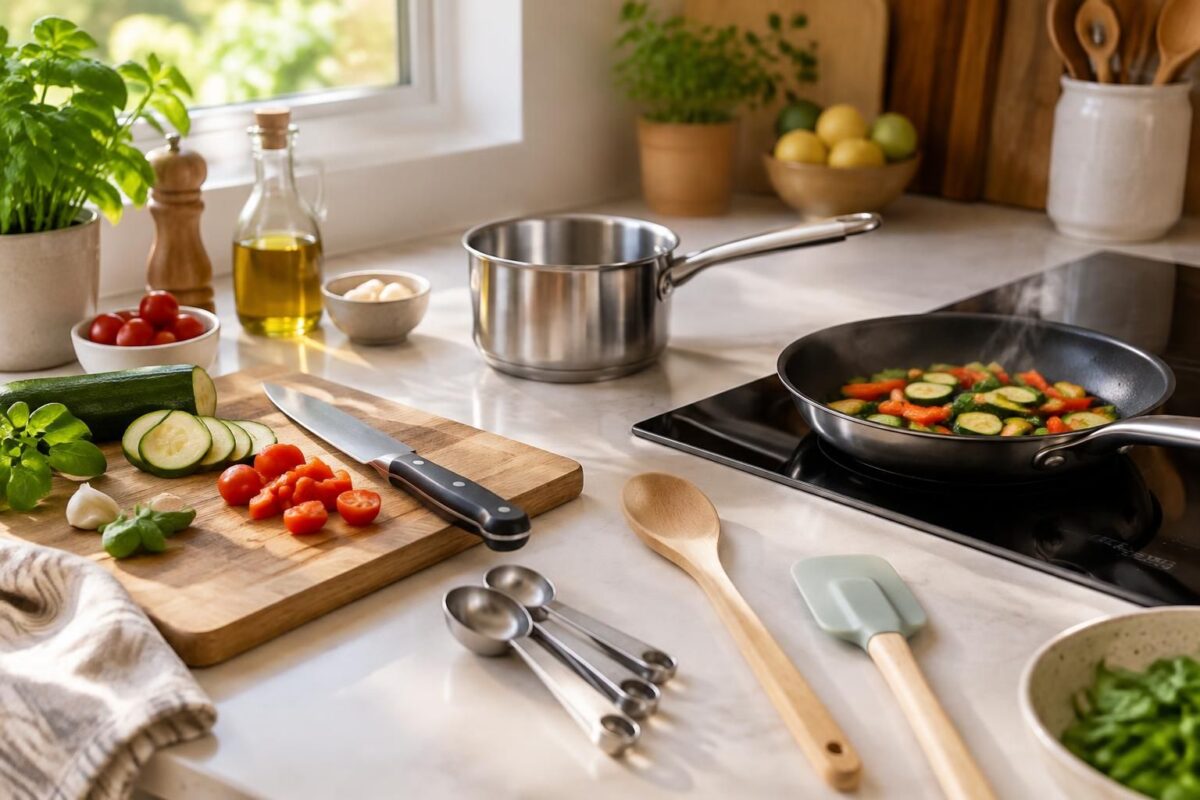
A student preparing a quick dinner can, for example, cut a zucchini with his knife, sauté it in a small skillet, then store the leftovers in a container. To discover other tools suited to everyday life, also check this selection of utensils to buy first and this guide on materials of wood, stainless steel or silicone.
Practical utensils: comparing formats for small portions
Large utensils are not always more practical when you cook alone. A pan that is too wide can make cooking a small piece of fish less even, while a huge pot takes up space and requires more water to cook a small amount of pasta.
The ideal size depends on your usual meals. A 20 to 24 cm mini-skillet often suits eggs and individual portions; a compact rice cooker can be useful if rice appears on the menu frequently, but it is not essential for everyone.
| Utensil | What it is used for | Useful if you cook often… |
|---|---|---|
| Mini-skillet | Sear or reheat a small amount | Eggs, vegetables or a small piece of fish |
| Single-serving saucepan | Cook, boil or prepare a sauce | Pasta, rice or a soup for one person |
| Compact rice cooker | Cook rice with little supervision | Rice several times a week |
| Kitchen scale | Weigh ingredients precisely | Recipes measured to the gram or small portions |
| Storage containers | Keep leftovers and organize meals | Preparations to reuse the next day |
A specialized appliance is of value only if it truly serves a purpose. If rice is occasional, a small saucepan will do; if it is frequent, the compact rice cooker can simplify the routine.
Essential kitchen utensils according to your habits
To begin, rely on tools that serve multiple tasks. A well-maintained versatile knife cuts most ingredients, while a flexible spatula stirs without damaging a non-stick pan and helps you scoop food from a bowl.
The colander, whisk and wooden spoon become useful depending on the recipes. In baking, the kitchen scale is particularly practical: it allows weighing a small amount of flour more precisely than a measuring cup.
- For quick meals: knife, cutting board, mini-skillet and spatula.
- For slow-cooked dishes: single-serving saucepan, lid and wooden spoon.
- For batch cooking: scale, mixing bowl and storage containers.
- For preparing vegetables: vegetable peeler and compact colander.
The shape also helps recognize each tool: the ladle carries liquids with its hollow scoop, while the skimmer drains them thanks to its openings. Choosing a utensil by its function helps avoid buying duplicates.
Wood, stainless steel or silicone: choosing utensils suited
The material matters as much as the size. Stainless steel is solid and durable, but it can scratch a non-stick coating; for this type of pan, wood or food-grade silicone are better choices.
Wood is gentle on surfaces and pleasant to use, but is usually washed by hand. Silicone resists heat well and is suitable for flexible spatulas, while nylon, often economical, does not handle high temperatures as well.
A common mistake is to use a fork or a metal spatula in a non-stick pan. The coating can be damaged: favor a soft utensil and hand-wash knives to preserve their edge.
Equip a small kitchen in three steps
- Identify your usual meals. If you mostly prepare eggs, vegetables and pasta, start with a mini-skillet, a single-serving saucepan and a versatile knife.
- Add tools that save you time. A kitchen scale helps to dose; a compact rice cooker only becomes useful if you cook with it regularly.
- Build up according to recipes. Then choose a whisk, a colander or storage containers according to your needs, rather than buying a whole set all at once.
This method keeps drawers light and the countertop available. A few well-chosen utensils are enough to cook a varied range of dishes, even in a one-person kitchen.
Practical questions about cooking for one
What utensils to buy first when cooking alone?
Start with a versatile knife, a cutting board, a mini-skillet, a single-serving saucepan, and a spatula. Add the other tools according to the recipes you prepare most often.
Is a compact rice cooker essential?
No. A saucepan is enough if you prepare rice from time to time. The compact rice cooker can be handy if you cook with it several times a week and want to limit supervision.
What size pan should you choose for one person?
A mini-skillet of about 20 to 24 cm generally suits eggs, vegetables and single portions. Choose its diameter according to your usual dishes and the size of your burners.
How to store leftovers from a single-serving meal?
Let the food cool, then place them in clean and appropriate storage containers. Containers of varying sizes avoid keeping too much air with a small portion.
Thanks for reading! Feel free to share your observations in the comments. — Claude


